

RENU SURESH
Expert
Published on: Mar 26, 2026
Intellectual Property (IP) in the UAE: Laws, Types, Registration Procedure
Intellectual property (IP) is a cornerstone of business success in the UAE, making it essential for every entrepreneur and investor to grasp its significance. As the UAE continues to experience rapid economic growth with a strong emphasis on innovation, protecting intellectual property rights has never been more critical.
This guide provides a comprehensive overview of intellectual property in the UAE, including the legal framework, registration procedures, and key benefits. By understanding the fundamentals of IP protection, businesses can safeguard their innovative ideas, products, and services, ensuring they remain competitive in this dynamic market.
Protect your Brand Now - Register your trademark and other intellectual properties safely and securely!
What is Intellectual Property?
Intellectual property (IP) refers to intangible assets such as trademarks, patents, copyrights, trade secrets, symbols, and other literary and artistic works protected by law. IP protection plays a crucial role in promoting innovation, fostering creativity, and ensuring that individuals and businesses can fully benefit from their original ideas and creations.
Similar to physical property rights, Intellectual Property Rights (IPR) grant owners exclusive control over their innovations, allowing them to profit from their work. These rights empower proprietors to prevent unauthorised use, modification, or distribution of their intellectual assets. In cases of infringement, the owner has the legal authority to take action, halt violations, and seek compensation for any damages incurred.
Types of Intellectual Property in the UAE
The UAE provides legal protection for various types of intellectual property (IP) to encourage innovation and safeguard the rights of creators and businesses. The main categories of IP in the UAE include:
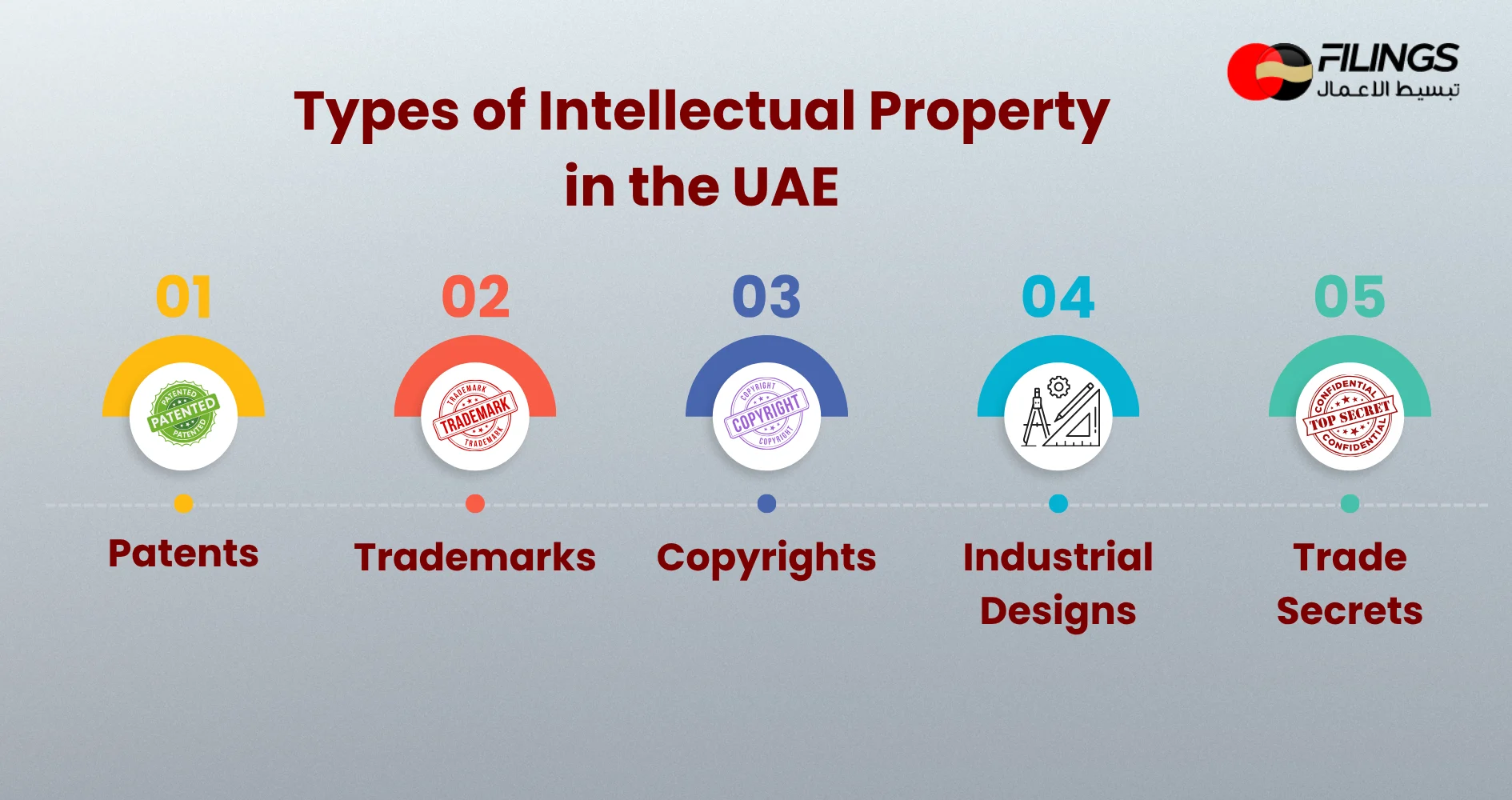
- Patents
- Trademarks
- Copyrights
- Industrial Designs
- Trade Secrets
Intellectual Property Law in the UAE
The intellectual property (IP) laws in the UAE are designed to protect the rights of creators, inventors, and businesses, ensuring their innovations and brand identities are legally safeguarded.
Key Intellectual Property Laws in the UAE
The UAE's IP framework is governed by several federal laws, including:
- Federal Law No. 31 of 2006 – Regulation and Protection of Industrial Property Rights (covering patents and industrial designs)
- Federal Law No. 37 of 1992 – Governing trademarks and their registration
- Federal Law No. 7 of 2002 – Protection of copyrights and related rights
- Federal Decree-Law No. 36 of 2021 – The latest trademark law amendments
- Federal Law No. 38 of 2021 – Updated copyright law
These laws ensure that individuals and businesses have exclusive rights over their intellectual property and provide mechanisms for enforcement against infringement.
IP Protection and Enforcement in the UAE
To handle IP-related disputes, the UAE has a specialised court system, including the Abu Dhabi Commercial Court, which hears trademark, patent, and copyright infringement cases. Additionally, enforcement actions can be taken through the Ministry of Economy, customs authorities, and civil or criminal courts to prevent counterfeiting and unauthorised use of intellectual property.
With strong legal protections and international agreements in place, the UAE remains a business-friendly environment for entrepreneurs, innovators, and companies looking to secure their intellectual property rights.
International IP Treaties and Agreements in the UAE
The UAE is a signatory to several international treaties that strengthen its IP protection framework, including:
- World Intellectual Property Organization (WIPO) Convention
- Paris Convention for the Protection of Industrial Property
- Berne Convention for the Protection of Literary and Artistic Works
- Trade-Related Aspects of Intellectual Property Rights (TRIPS) Agreement
- Madrid Protocol for International Trademark Registration
- Patent Cooperation Treaty (PCT) for International Patent Protection
These agreements allow businesses to register and enforce their intellectual property across multiple jurisdictions, making the UAE a globally aligned IP hub.
Benefits of Intellectual Property Registration in the UAE
Registering intellectual property (IP) in the UAE offers numerous advantages for businesses, entrepreneurs, and creators. By securing legal protection, individuals and companies can safeguard their innovations and gain a competitive edge.
- Legal Protection Against Infringement: Registering IP grants the owner exclusive rights, preventing unauthorised use, reproduction, or distribution of their creations. In case of infringement, legal action can be taken to stop violations and claim compensation for damages.
- Exclusive Commercial Rights: IP registration allows businesses to monetise their innovations by licensing, franchising, or selling their intellectual property. This can generate additional revenue streams and enhance business growth.
- Brand Reputation and Market Trust: A registered trademark or patented product enhances consumer trust by ensuring authenticity and quality. Customers are more likely to choose products or services that are legally protected, reducing the risk of counterfeit goods in the market.
- Competitive Advantage: Owning registered IP helps businesses differentiate themselves from competitors by securing unique products, brand elements, or technologies. This exclusivity strengthens the market position and boosts brand recognition.
- Expansion Opportunities: Registered intellectual property facilitates international business expansion by providing legal protection in multiple jurisdictions, especially if registered under global treaties like the Madrid Protocol for trademarks or the Patent Cooperation Treaty (PCT).
- Encouragement of Innovation and Investment: IP protection encourages businesses and entrepreneurs to invest in research and development (R&D), fostering continuous innovation. Investors and stakeholders are also more likely to support businesses with legally protected assets.
- Protection of Creative and Artistic Works: For authors, artists, and creators, copyright registration ensures exclusive ownership of literary, artistic, and musical works. This protects their creative efforts from unauthorised reproduction or distribution.
By securing intellectual property rights in the UAE, businesses and individuals can protect their innovations, enhance profitability, and establish long-term success in a competitive marketplace.
How to Register Intellectual Property (IP) in the UAE?
Registering Intellectual Property (IP) in the UAE involves filing applications with the Ministry of Economy based on the type of IP—trademarks, patents, copyrights, industrial designs, or trade secrets. The process typically includes checking availability, submitting an application with required documents, paying fees, and undergoing examination and publication. Once approved, the applicant receives a registration certificate, granting exclusive legal rights.
Now, let's delve into the key types of Intellectual Property (IP) in the UAE, exploring their definitions, legal protections, and registration procedures in detail.
Intellectual property (IP): Trademarks in the UAE
A trademark is any visible sign that helps distinguish the goods or services of one business from another. This can include words, logos, shapes, colours, sounds, or any other distinctive sign that can be graphically represented. Trademarks play a crucial role in branding, allowing businesses to establish a unique identity in the market.
Trademark Law in the UAE
Trademark protection in the UAE is governed by Federal Decree-Law No. 36 of 2021 on Trademarks. Under this law, a trademark is defined as any unique representation of:
- Words, names, or signatures
- Figures, graphics, or letters
- Logos, titles, or seals
- Hallmarks, pictures, or advertisements
- Patterns, packaging, or other distinctive marks
- A combination of any of the above
These trademarks must be used—or intended to be used—to differentiate products, goods, or services from those of other businesses.
Who Can Register a Trademark in the UAE?
Under Federal Decree-Law No. 36 of 2021, the following entities are eligible to register a trademark:
- UAE nationals and any natural or legal entities
- Foreign individuals and entities operating businesses in the UAE
- Foreign individuals and entities engaged in commercial, industrial, or service activities in a country that allows UAE nationals to do the same under the law of reciprocity
- Other legal entities recognised under UAE law
Trademark Registration in the UAE
Registering a trademark in the UAE is essential for businesses looking to protect their brand identity and prevent unauthorised use of their distinctive marks. The process is regulated by the Ministry of Economy's Trademark Office and follows a structured application and approval procedure.
Steps to Register a Trademark in the UAE
To register a trademark, the applicant must submit an application to the Trademark Office at the Ministry of Economy. The application must include:
- Applicant’s name and address
- A clear representation of the trademark
- A statement of goods or services for which the trademark has already been used (if applicable)
- A list of goods or services to be covered by the trademark
- The classification of goods or services as per the Nice Classification System
Required Documents for Trademark Registration
The applicant must provide the following documents:
- Trademark logo (high-resolution image)
- Power of Attorney (if applying through a legal representative)
- Copy of commercial license (for business entities)
- Passport copy (for individual applicants)
- Priority document (if claiming priority from an earlier application in another country)
- Other supporting attachments (as required)
Examination and Publication Process
- Trademark Examination – The Trademark Office reviews the application to ensure compliance with UAE Trademark Law.
- Publication in the Trademark Journal – If approved, the trademark is published in the Trademark Journal for opposition purposes.
- Opposition Period – Third parties have 30 days from the date of publication to file an objection.
- Final Registration – If no opposition is filed within the given timeframe, the trademark is officially registered, and the applicant receives a registration certificate.
By registering a trademark, businesses can secure exclusive rights over their brand identity, ensuring protection against unauthorised use and enhancing market credibility.
Intellectual property (IP): Copyright in the UAE
Copyright law in the UAE safeguards the rights of creators over their original works, ensuring they receive recognition and control over how their works are used. Governed by Federal Law No. 38 of 2021 on Copyrights and Neighboring Rights, copyright protection applies to various fields of literature, arts, and science, regardless of the form, meaning, or purpose of the work.
Types of Works Protected by Copyright in the UAE
Copyright law in the UAE protects a wide range of intellectual and creative works, including:
- Literary works – Books, articles, essays, research papers, and written content
- Computer software and applications
- Lectures, speeches, and public addresses
- Dramatic works – Plays, scripts, and theatrical performances
- Musical compositions – With or without lyrics
- Audiovisual works – Films, videos, radio, and television programs
- Architectural designs – Building plans and structures
- Visual art – Paintings, sculptures, photographs, drawings, and maps
- Derivative works – Adaptations or modifications of existing copyrighted works
- Broadcasting materials – Including the title of the work and its creative concept
Additionally, the Minister of Economy has the authority to recognise other forms of creative works, such as databases and similar intellectual creations, under copyright protection.
Copyright Registration in the UAE
While copyright protection in the UAE is granted automatically upon the creation of an original work, registering a copyright with the Ministry of Economy provides stronger legal evidence of ownership and simplifies enforcement in case of disputes.
- To register a copyright, the applicant must submit an application along with details of the work, proof of authorship, and any required supporting documents.
- Once approved, the applicant receives an official copyright certificate, granting them exclusive rights to use, reproduce, distribute, and license the work.
Copyright registration not only safeguards creative works from infringement but also enhances their commercial value, making them easier to license or sell.
Intellectual property (IP): Patents in the UAE
A patent is a legal right granted to inventors or assignees, giving them exclusive control over their invention for a limited period. This protection prevents others from manufacturing, using, selling, or distributing the patented invention without permission. In exchange, the inventor must publicly disclose details of the invention, contributing to technological advancement.
Patent Law in the UAE
Patent protection in the UAE is governed by Federal Law No. 31 of 2016, which amends Law No. 17 of 2002 on the Regulation and Protection of Industrial Property of Patents, Industrial Drawings, and Designs. Under this law, patent rights are granted to new inventions that result from innovative ideas or improvements, provided they have a scientific basis and can be applied across all fields of technology.
Patent Registration in the UAE
Patent registration in the UAE is a crucial step for inventors and businesses to secure exclusive rights over their innovations. The International Centre for Patent Registration (ICPR) under the Ministry of Economy is responsible for handling patent applications. A patent grants the inventor the right to commercialise, license, or sell their invention while preventing unauthorised use.
Eligibility for Patent Registration
To be eligible for patent protection in the UAE, an invention must meet the following criteria:
- Novelty – The invention must be new and not previously disclosed to the public.
- Inventive Step – It must involve a significant improvement that is not obvious to a person skilled in the relevant field.
- Industrial Applicability – The invention must be applicable and useful in an industrial or technological sector.
Documents Required for Patent Registration
Applicants must submit the following documents:
- Patent application form (completed online through the Ministry of Economy's portal)
- Detailed description of the invention (including its function and benefits)
- Claims defining the scope of protection
- Drawings or diagrams (if applicable)
- Abstract of the invention (a summary of the key features)
- Copy of passport or Emirates ID (for individuals)
- Commercial license (for businesses)
- Power of Attorney (if applying through an agent)
- Priority document (if claiming priority from an earlier foreign application)
Patent Examination Process
- Application Submission – The applicant files the patent application through the Ministry of Economy's website.
- Formal Examination – The ICPR reviews the application to ensure all required documents are submitted correctly.
- Substantive Examination – The invention is assessed for novelty, inventive step, and industrial applicability.
- Publication for Opposition – If the patent meets the requirements, it is published in the Official Gazette for public opposition.
- Grant of Patent – If no objections are filed within the given period, the patent is officially granted, and the applicant receives a patent certificate.
Patent protection in the UAE is typically valid for 20 years from the date of application, provided renewal fees are paid annually.
Penalties for Intellectual Property Infringement
IP violations in the UAE carry strict penalties, including:
- The amount varies depending on the severity of the infringement.
- Confiscation and destruction of counterfeit goods to prevent their distribution.
- Imprisonment for repeat offenders or large-scale counterfeit operations.
- Business license suspension or cancellation for companies involved in IP violations.
Intellectual property (IP): What is an Industrial Design?
An industrial design refers to the aesthetic or ornamental aspects of a product, including its shape, pattern, configuration, or decoration, that make it visually distinctive. This protection ensures that businesses and designers can prevent unauthorised copying of their innovative product designs.
Industrial Design Registration in the UAE
Industrial designs can be registered through the Ministry of Economy, ensuring exclusive rights to the owner for a period of 10 years from the filing date. The registration process includes:
- Filing an application with a detailed description and illustrations.
- Examination by authorities to ensure novelty and uniqueness.
- Publication for opposition, allowing third parties to challenge the design.
- Grant of design protection, providing exclusive rights to use, license, or sell the design.
Industrial Design Protection in the UAE
Industrial designs in the UAE are legally protected under Federal Law No. 31 of 2016, which regulates patents, industrial designs, and industrial drawings. Registering an industrial design grants the owner exclusive rights to use, manufacture, license, or sell the design while preventing unauthorised reproduction.
Eligibility Criteria for Industrial Design Registration
To qualify for industrial design protection in the UAE, a design must meet the following requirements:
- Novelty – The design must be new and original, meaning it has not been publicly disclosed before filing.
- Distinctiveness – The design should have unique visual features that distinguish it from existing products.
- Industrial Applicability – The design must be capable of being produced and used in an industrial or commercial setting.
- Exclusion Criteria – Designs dictated purely by technical function or those that violate public order or morality are not eligible for protection.
Required Documents for Industrial Design Registration
Applicants must submit the following documents to the UAE Ministry of Economy:
- Completed application form
- Detailed description of the design
- High-quality drawings or photographs (illustrating all perspectives)
- Priority document (if claiming priority from an earlier application)
- Copy of passport or Emirates ID (for individuals)
- Trade license (for companies)
- Power of Attorney (if applying through an agent)
Industrial Design Registration Process in the UAE
- Application Submission – The applicant files an industrial design application online through the Ministry of Economy’s website.
- Formal Examination – The Ministry reviews the application to ensure all required documents are complete.
- Substantive Examination – The design is assessed for novelty, distinctiveness, and industrial applicability.
- Publication for Opposition – If the design meets legal requirements, it is published in the Official Gazette for potential opposition.
- Grant of Registration – If no objections are raised within 90 days, the design is officially registered and protected for 10 years.
Trade Secrets Protection in the UAE
A trade secret refers to confidential business information that provides a company with a competitive advantage, such as formulas, processes, customer lists, or proprietary methods.
Legal Framework for Trade Secrets in the UAE
Trade secrets are protected under:
- UAE Commercial Transactions Law
- Federal Decree-Law No. 31 of 2021 (Penal Code) – Criminal penalties for unauthorised disclosure.
- Employment Contracts & NDAs – Companies use Non-Disclosure Agreements (NDAs) to protect trade secrets from employees and third parties.
Key Aspects of Trade Secret Protection
- No formal registration is required – Unlike trademarks or patents, trade secrets are protected as long as they remain confidential.
- Legal action can be taken against anyone who discloses or misuses trade secrets without authorisation.
- Employees and business partners can be held liable for breaching confidentiality agreements.
FAQs About Intellectual Property (IP) in the UAE
1. What is considered Intellectual Property (IP) in the UAE?
Intellectual Property (IP) in the UAE includes trademarks, patents, copyrights, industrial designs, and trade secrets. These protect business identities, inventions, creative works, and confidential business information.
2. How can I register my intellectual property (IP) in the UAE?
IP registration in the UAE is handled by the Ministry of Economy. Trademarks, patents, and industrial designs require an application, relevant documentation, and fees. Copyrights are automatically protected upon creation, but registration is recommended for legal proof.
3. What are the penalties for intellectual property (IP) infringement in the UAE?
Penalties include fines, confiscation of counterfeit goods, imprisonment for repeat offenders, and business license suspension or cancellation.
4. How long does trademark protection last in the UAE?
A trademark is valid for 10 years from the registration date and can be renewed indefinitely every 10 years.
5. Is international trademark protection available in the UAE?
Yes, the UAE is a member of the Madrid Protocol, allowing businesses to register trademarks internationally in multiple countries through a single application.
6. Can I register my patent internationally from the UAE?
Yes, the UAE is part of the Patent Cooperation Treaty (PCT), enabling inventors to seek patent protection in multiple jurisdictions with a single international application.
7. Do I need to register a copyright in the UAE?
No, copyright protection is automatic upon creation. However, registering your copyright with the UAE Ministry of Economy provides stronger legal proof in case of disputes.
8. How can businesses protect trade secrets in the UAE?
Trade secrets are protected through Non-Disclosure Agreements (NDAs), confidentiality clauses, and UAE commercial laws. Unauthorised disclosure or misuse can lead to legal penalties.
9. How long does patent protection last in the UAE?
Patent protection in the UAE lasts for 20 years from the filing date, provided annual renewal fees are paid.
10. How can I enforce my intellectual property rights in the UAE?
Enforcement can be done through civil and criminal courts, customs authorities, and regulatory bodies like the Ministry of Economy. Legal action can stop infringement and claim compensation.